


Understanding Core Antibody Principles: Keys to Successful Immunological Experiments
 source:ELK Biotechnology
 date:2026-08-13
 views:244
Researchers performing immunological assays are well aware that the sensitivity, specificity and background signal of ELISA ultimately depend on the structural integrity and functional‑domain activity of antibodies.
Many experimental challenges — poor specificity, high non‑specific binding, weak signals, significant batch‑to‑batch variation and unstable color development — often stem not from operational errors, but from inappropriate antibody selection and assay matching.
As a primary manufacturer of antibodies and ELISA kits, we break down complex textbook knowledge and thoroughly dissect the full antibody architecture, two major functional regions and sub‑domains from a practical experimental perspective. This deep‑dive helps researchers grasp the underlying principles of immunological experiments and make informed product‑selection decisions efficiently.
01 Basic Antibody Scaffold: The Classic Y‑Shaped Four‑Chain Structure
All conventional IgG antibodies feature a symmetric Y‑shaped four‑polypeptide‑chain structure assembled via disulfide‑bond cross‑linking, delivering stable and well‑compartmentalized architecture.
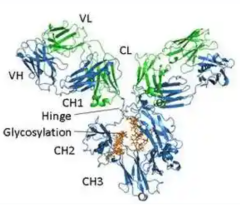
- Two heavy chains (H‑chains): Run through the entire antibody, forming the Y‑shaped backbone and base. They determine antibody isotypes (IgG / IgM / IgA, etc.) and core functional properties.
- Two light chains (L‑chains): Symmetrically located on the two arms of the Y‑shape. They only contribute to the antigen‑recognition domain and do not define antibody isotype.
Inter‑chain and intra‑chain disulfide bonds are critical for structural stability. During antibody and kit manufacturing, storage and shipping, disulfide‑bond breakage triggers collapse of the antibody spatial conformation. This directly abolishes antigen‑binding activity, elevates non‑specific binding and causes sharp signal attenuation. Experimental workflows should therefore avoid conditions that disrupt disulfide bonds.
Functionally, antibodies are divided into two independent core regions: the Fab (antigen‑binding fragment) and the Fc (constant fragment), each performing distinct roles.
02 Fab Region: The Core Determinant of ELISA Specificity
The Fab segments correspond to the two upper arms of the Y‑shaped antibody. This is the only domain capable of specific antigen binding. It directly governs assay specificity and targeting accuracy and represents the primary functional unit of antibodies in experiments.
Sub‑domains of the Fab Region: Variable (V) Region and Constant (C) Region
Each Fab fragment contains one heavy‑chain variable domain (VH), one light‑chain variable domain (VL), and their corresponding constant domains. Antigen‑recognition capacity is chiefly conferred by the combined variable segments (VH + VL).
Within the variable domains lie the complementarity‑determining regions (CDRs) — the key targeting‑recognition sites and the core value of research‑grade and diagnostic antibodies.
- Each variable domain contains three CDR loop structures with highly diverse amino‑acid sequences that precisely match epitopes on different antigens.
- Amino‑acid sequences within CDRs directly define antibody specificity, affinity and titer.
- Flanking framework regions (FRs) support CDR architecture and preserve stable antigen‑binding conformation.
When producing high‑specificity antibodies, our core quality‑control priority is to preserve intact CDR conformation, uniform affinity and the absence of off‑target binding sites. This eliminates false‑positive results and high background signals at the source. Framework regions are also essential for antibody stability and expression yield.
03 Fc Region: Cornerstone for Signal Amplification and Assay Stability
The Fc segment is the constant domain forming the base of the Y‑shaped antibody. It does not participate in antigen binding, yet governs secondary antibody functions and assay compatibility. It is indispensable for secondary‑antibody recognition, signal amplification and overall system stability.
Key Functions of the Fc Region
- Secondary‑antibody binding site: Most enzyme‑labeled secondary antibodies recognize the Fc domain of primary antibodies. HRP‑ or AP‑conjugated secondary antibodies bind specifically to primary‑antibody Fc regions to form antibody complexes, enabling signal readout for immunological assays.
- Conjugation site: Many detection workflows require HRP‑enzyme or biotin conjugation onto antibodies. Conjugation targeting the Fab domain risks interfering with antigen‑antibody interaction and yields inconsistent labeling due to high sequence variability. For this reason, conjugation is mostly performed on the Fc region, often at defined amino‑acid residues to achieve site‑specific labeling.
- Antibody coating performance: The Fc domain influences adsorption capacity during ELISA plate coating.
- Isotype and assay compatibility: Differences between IgG, IgM and other isotypes originate entirely from the Fc region. Isotype determines coating stability, secondary‑antibody compatibility and buffer tolerance.
- Global antibody stability: The highly conserved Fc domain confers robust intrinsic stability. It impacts thermotolerance and freeze‑thaw resistance, governing kit shelf‑life and batch‑to‑batch consistency.
Conclusion: Understand Antibody Structure to Optimize Assay Performance
In short, the two antibody functional domains have highly specialized roles: the Fab region “recognizes the correct target”, while the Fc region “enables robust assays and amplifies signals”.
Specificity, sensitivity and reproducibility in all immunological experiments rely entirely on structural integrity and full functionality of these two domains.
Our in‑house‑produced antibodies feature full traceability at every stage: starting from sequence design, through expression and purification, antibody‑pair screening and process optimization, to final sample testing. This provides reliable guarantees for product stability and quality.

 RETURN