


Disulfidptosis & Cuproptosis: Emerging Frontiers in Cancer Therapy
 source:ELK Biotechnology
 date:2026-11-16
 views:67
Apoptosis, necrosis, pyroptosis, and ferroptosis have already been written into textbooks. Between 2022 and 2026, two new forms of cell death emerged: disulfidptosis and cuproptosis. Each started from a single paper and within a few years became two of the hottest directions in targeted cancer therapy. The progress in 2026 converges on the same point—mechanistic research is beginning to shift toward clinical translation, with new targets, new drugs, and new combination regimens appearing one after another. This article clarifies the full story of both pathways and their current positions, and also explains where Kelu Biotechnology's ELISA kits can fit into the work.
I. Disulfidptosis: When the Cancer Cell's "Skeleton" Collapses
(I) Mechanism: Disulfide Bonds Weld the Skeleton Shut
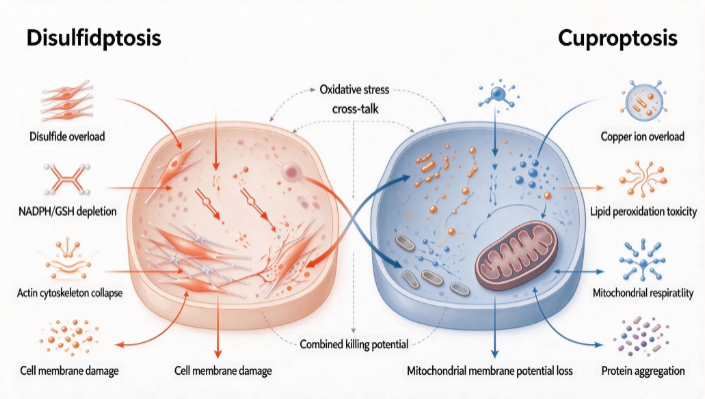
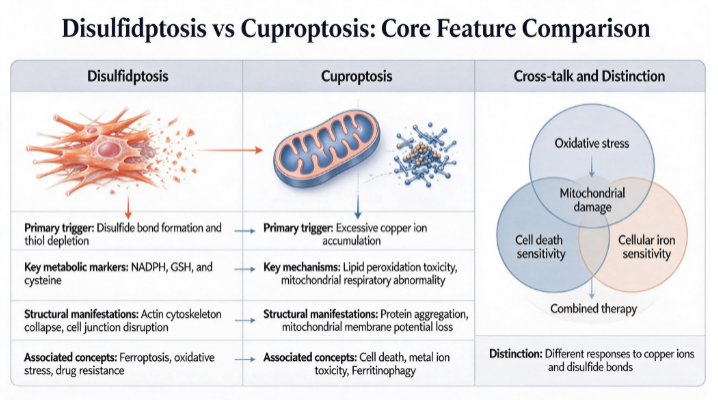
Disulfidptosis was first reported in 2023 by a team at the MD Anderson Cancer Center in the United States. Simply put, when disulfide stress in the cell piles up beyond a threshold, the actin cytoskeleton becomes cross-linked by disulfide bonds into insoluble aggregates. The network can no longer hold, and the cell collapses. Three molecules determine whether this chain can proceed.
SLC7A11 is the key subunit of the cystine/glutamate antiporter (System Xc⁻). When it is highly expressed, cancer cells become more dependent on cystine uptake and accumulate it faster intracellularly.
NADPH supplies reducing power. When glucose is scarce, NADPH levels cannot keep up, incoming cystine cannot be reduced, and disulfide bonds form in large quantities inside the cell.
Finally, the effect lands on actin—disulfide bonds directly cross-link the filaments, the cytoskeleton disintegrates, and the cell loses both its adherent morphology and viability.
There is an easily overlooked prerequisite for identification: glucose deprivation alone is not sufficient. The standard condition is SLC7A11 high expression combined with glucose starvation. Additionally, the phenotype is only confirmed when three types of inhibitors (zVAD-fmk, Fer-1, VX-765) all fail to rescue, while supplementation with DTT can reverse the effect.
(II) Progress in 2026
New targets are emerging on both sides of SLC7A11. SLC3A2 is its chaperone subunit—without it, the transporter cannot reach the membrane. TXNRD1 (thioredoxin reductase 1) is one of the major NADPH-consuming enzymes in the cell; its activity level directly determines how much reducing power remains to handle disulfides. Inhibiting TXNRD1 together with glucose starvation is currently a common sensitization strategy.
Drugs are still at the animal model stage. Disulfiram derivatives are being repeatedly tested. A novel small molecule DS-001, targeting the SLC7A11–NADPH dual pathway, has shown significant tumor inhibition in animal experiments and is scheduled to enter Phase I clinical trials in 2027.
Combination therapy has now connected to immunotherapy: disulfidptosis inducers upregulate MHC-I expression on tumor cells. When combined with PD-1 inhibitors, the complete response rate in mouse models has improved significantly.
II. Cuproptosis: "Detonating" Mitochondria with Copper Ions
(I) Mechanism: Copper Aggregates Proteins
Cuproptosis was first reported in 2022 in Science by Todd Golub's team at the Broad Institute. Excess copper ions directly bind to lipoylated proteins in the tricarboxylic acid (TCA) cycle—DLAT and DLST are the two most typical examples. The proteins then aggregate, iron-sulfur cluster synthesis is blocked, and the cell ultimately dies from proteotoxic stress.
It has three easily recognizable features:
Dependence on mitochondrial respiration (oxidative phosphorylation)
Resistance to inhibitors of apoptosis, ferroptosis, and pyroptosis
High sensitivity to copper ionophores (e.g., elesclomol)
A side note: cuproptosis is often confused with ferroptosis. The core of ferroptosis is lipid peroxidation, which can be rescued by Fer-1. The core of cuproptosis is protein aggregation, which can only be rescued by copper chelators. When performing rescue experiments, run the two groups separately to draw valid conclusions.
(II) Progress in 2026
New targets are focused on two directions. The phosphorylation status of FDX1 (ferredoxin 1) determines the cell's sensitivity to copper. ATP7A/ATP7B are copper efflux pumps; inhibiting them leads to intracellular copper accumulation and enhanced cuproptosis.
Several drug candidates are worth following:
Elesclomol combined with paclitaxel has shown disease control in platinum-resistant ovarian cancer.
Cu(II)-GTC, developed by a Chinese team, has received FDA Orphan Drug designation.
pH-responsive copper-based nanoparticles achieve "targeted detonation," with significant tumor regression in mouse models.
The mechanism of combination therapy has also been filled in: DAMPs released by cuproptosis activate the cGAS-STING pathway, enhancing anti-tumor immunity. When combined with radiotherapy, the complete response rate in locally advanced cervical cancer has also improved.
III. Kelu Biotechnology Product Recommendations: Accurate Detection to Support Cutting-Edge Research
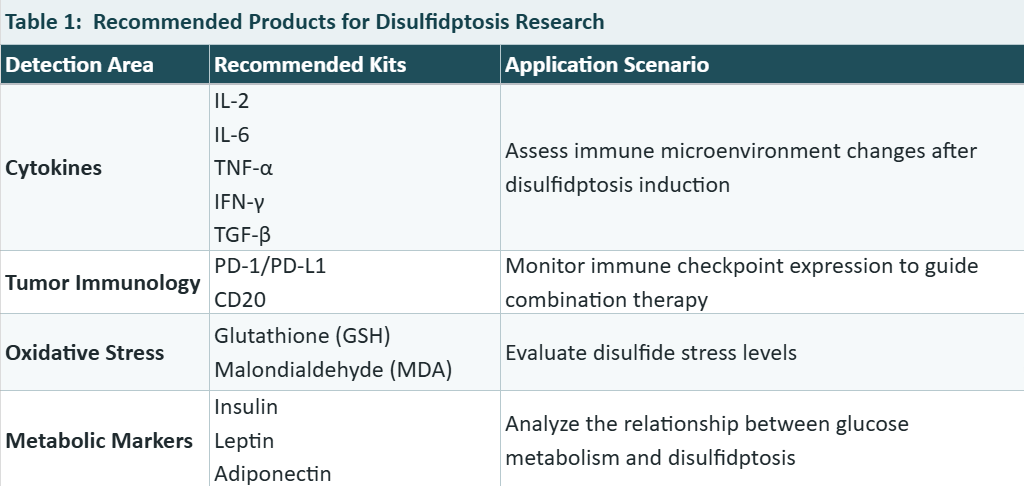
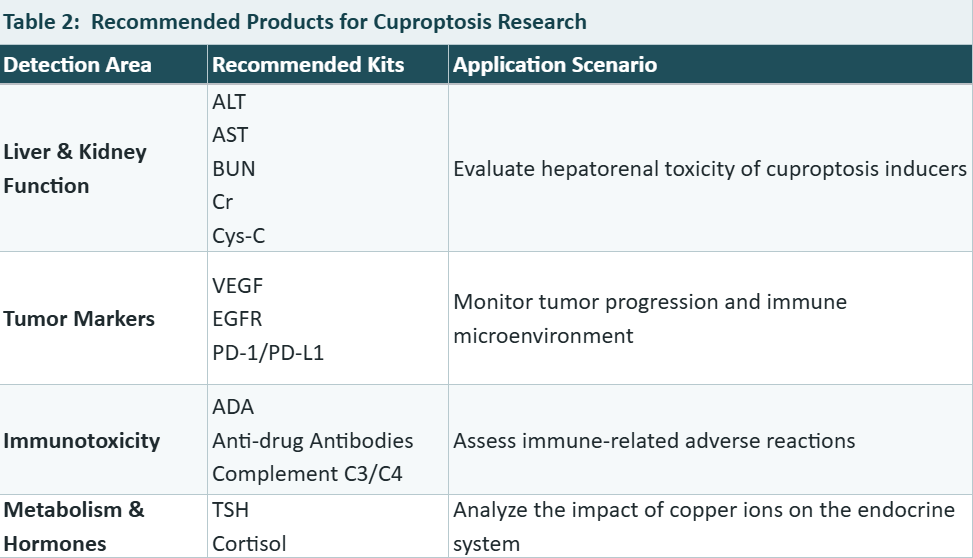
To advance both pathways, detection of key proteins, metabolites, and toxicity indicators is unavoidable. Kelu Biotechnology currently offers approximately 300 ELISA kits covering cytokines, tumor markers, liver and kidney function, immunotoxicity, oxidative stress, and more, which can be configured according to the research stage.
Table 1: Recommended Products for Disulfidptosis Research
Research Recommendations
For disulfidptosis research: pair the cytokine panel (IL-2, IL-6, TNF-α) with PD-1/PD-L1 to evaluate the degree of immune activation.
For cuproptosis research: use the liver and kidney function panel (ALT, AST, BUN, Cr) to monitor drug safety, and VEGF/EGFR to track changes in tumor angiogenesis.
A note of caution: ELISA measures the concentration of proteins secreted into the supernatant or serum, reflecting overall levels. It cannot replace Western blot for detecting intracellular aggregates, nor can it replace flow cytometry for phenotype determination. Clarifying the division of labor in advance ensures that the data can be properly interpreted.
IV. Outlook: Key Milestones from 2027 to 2028
2027: The first disulfidptosis inducer (DS-001 or a similar molecule) is expected to enter Phase I clinical trials; Phase II data for elesclomol combined with immunotherapy are anticipated.
2028: Phase III trials for cuproptosis combined with radiotherapy may be initiated; FDX1 degraders based on PROTAC technology will enter preclinical optimization.
Looking further ahead, biomarker detection for disulfidptosis and cuproptosis (including liquid biopsy) has the potential to become part of routine pathology reports, making "treatment selection by cell death modality" a reality.
V. Conclusion
Neither pathway has yet yielded an approved drug—that is the honest truth. What they currently offer is a metabolic vulnerability that can be both detected and targeted. What Kelu Biotechnology's ELISA kits can do is to measure the key indicators along these pathways accurately and reliably, ensuring that the data can withstand repetition.

 RETURN
