




KIR3.1 (phospho Ser185) rabbit pAb
 One-click to copy product information
 Size: Size: |
 Price: Price: |
|---|---|
| 50 µL | $148.00 |
| 100 µL | $248.00 |
 Manual
 Overview
-
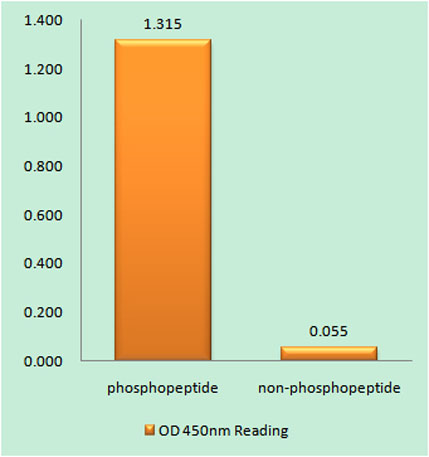
Enzyme-Linked Immunosorbent Assay (Phospho-ELISA) for Immunogen Phosphopeptide (Phospho-left) and Non-Phosphopeptide (Phospho-right), using GIRK1/KIR3.1/KCNJ3 (Phospho-Ser185) Antibody
-
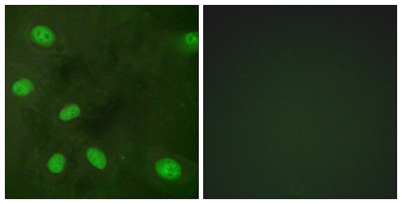
Immunofluorescence analysis of HeLa cells, using GIRK1/KIR3.1/KCNJ3 (Phospho-Ser185) Antibody. The picture on the right is blocked with the phospho peptide.
-
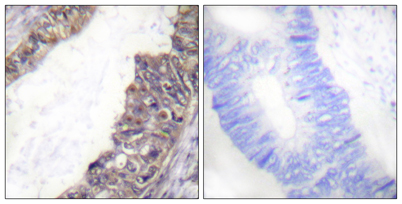
Immunohistochemistry analysis of paraffin-embedded human colon carcinoma, using GIRK1/KIR3.1/KCNJ3 (Phospho-Ser185) Antibody. The picture on the right is blocked with the phospho peptide.
-
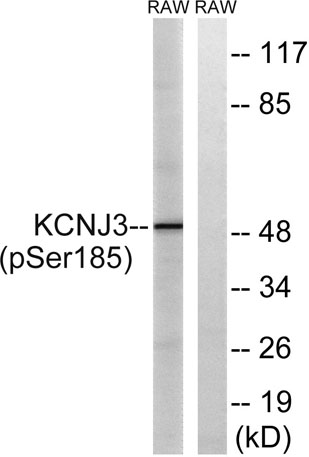
Western blot analysis of lysates from RAW264.7 cells treated with Insulin 0.01U/ml 15', using GIRK1/KIR3.1/KCNJ3 (Phospho-Ser185) Antibody. The lane on the right is blocked with the phospho peptide.