$148.00/50µL $248.00/100µL
| 50 µL | $148.00 |
| 100 µL | $248.00 |
| Product name: | Huntingtin (phospho Ser421) rabbit pAb |

| Reactivity: | Human;Mouse;Rat |
| Alternative Names: | HTT; HD; IT15; Huntingtin; Huntington disease protein; HD protein |
| Source: | Rabbit |
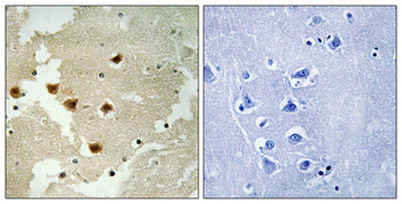
| Dilutions: | Immunohistochemistry: 1/100 - 1/300. ELISA: 1/5000. Not yet tested in other applications. |
| Immunogen: | The antiserum was produced against synthesized peptide derived from human Huntingtin around the phosphorylation site of Ser421. AA range:387-436 |
| Storage: | -20°C/1 year |
| Clonality: | Polyclonal |
| Isotype: | IgG |
| Concentration: | 1 mg/ml |
| Molecular Weight: | 348kD |
| GeneID: | 3064 |
| Human Swiss-Prot No: | P42858 |
| Cellular localization: | [Huntingtin]: Cytoplasm . Nucleus . Early endosome . The mutant Huntingtin protein colocalizes with AKAP8L in the nuclear matrix of Huntington disease neurons. Shuttles between cytoplasm and nucleus in a Ran GTPase-independent manner (PubMed:15654337). Recruits onto early endosomes in a Rab5- and HAP40-dependent fashion (PubMed:16476778). .; [Huntingtin, myristoylated N-terminal fragment]: Cytoplasmic vesicle, autophagosome . |
| Background: | huntingtin(HTT) Homo sapiens Huntingtin is a disease gene linked to Huntington's disease, a neurodegenerative disorder characterized by loss of striatal neurons. This is thought to be caused by an expanded, unstable trinucleotide repeat in the huntingtin gene, which translates as a polyglutamine repeat in the protein product. A fairly broad range of trinucleotide repeats (9-35) has been identified in normal controls, and repeat numbers in excess of 40 have been described as pathological. The huntingtin locus is large, spanning 180 kb and consisting of 67 exons. The huntingtin gene is widely expressed and is required for normal development. It is expressed as 2 alternatively polyadenylated forms displaying different relative abundance in various fetal and adult tissues. The larger transcript is approximately 13.7 kb and is expressed predominantly in adult and fetal brain whereas the smaller transcript of approximately 10.3 kb is more widel |