
$148.00/50µL $248.00/100µL
| 50 µL | $148.00 |
| 100 µL | $248.00 |
| Product name: | TCP-1 ε rabbit pAb |
| Reactivity: | Human;Mouse;Rat |
| Alternative Names: | CCT5; CCTE; KIAA0098; T-complex protein 1 subunit epsilon; TCP-1-epsilon; CCT-epsilon |
| Source: | Rabbit |
| Dilutions: | Western Blot: 1/500 - 1/2000. ELISA: 1/10000. Not yet tested in other applications. |
| Immunogen: | The antiserum was produced against synthesized peptide derived from human CCT5. AA range:241-290 |
| Storage: | -20°C/1 year |
| Clonality: | Polyclonal |
| Isotype: | IgG |
| Concentration: | 1 mg/ml |
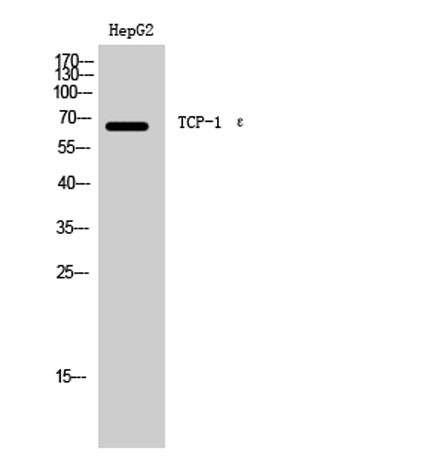
| Observed Band: | 67kD |
| GeneID: | 22948 |
| Human Swiss-Prot No: | P48643 |
| Cellular localization: | Cytoplasm . Cytoplasm, cytoskeleton, microtubule organizing center, centrosome . |
| Background: | The protein encoded by this gene is a molecular chaperone that is a member of the chaperonin containing TCP1 complex (CCT), also known as the TCP1 ring complex (TRiC). This complex consists of two identical stacked rings, each containing eight different proteins. Unfolded polypeptides enter the central cavity of the complex and are folded in an ATP-dependent manner. The complex folds various proteins, including actin and tubulin. Mutations in this gene cause hereditary sensory and autonomic neuropathy with spastic paraplegia (HSNSP). Alternative splicing results in multiple transcript variants. Related pseudogenes have been identified on chromosomes 5 and 13. [provided by RefSeq, Apr 2015], |