
$148.00/50µL $248.00/100µL
| 50 µL | $148.00 |
| 100 µL | $248.00 |
| Product name: | EphB2 rabbit pAb |
| Reactivity: | Human;Rat;Mouse; |
| Alternative Names: | EPHB2; DRT; EPHT3; EPTH3; ERK; HEK5; TYRO5; Ephrin type-B receptor 2; Developmentally-regulated Eph-related tyrosine kinase; ELK-related tyrosine kinase; EPH tyrosine kinase 3; EPH-like kinase 5; EK5; hEK5; Renal carcinoma antigen NY-REN-47 |
| Source: | Rabbit |
| Dilutions: | Western Blot: 1/500 - 1/2000. Immunohistochemistry: 1/100 - 1/300. ELISA: 1/5000. Not yet tested in other applications. |
| Immunogen: | The antiserum was produced against synthesized peptide derived from human EPHB2. AA range:991-1040 |
| Storage: | -20°C/1 year |
| Clonality: | Polyclonal |
| Isotype: | IgG |
| Concentration: | 1 mg/ml |
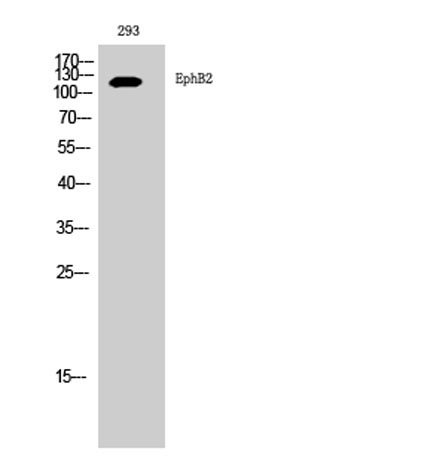
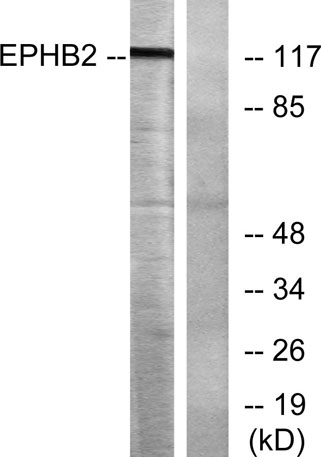
| Observed Band: | 117kD |
| GeneID: | 2048 |
| Human Swiss-Prot No: | P29323 |
| Cellular localization: | Cell membrane; Single-pass type I membrane protein. Cell projection, axon . Cell projection, dendrite . |
| Background: | This gene encodes a member of the Eph receptor family of receptor tyrosine kinase transmembrane glycoproteins. These receptors are composed of an N-terminal glycosylated ligand-binding domain, a transmembrane region and an intracellular kinase domain. They bind ligands called ephrins and are involved in diverse cellular processes including motility, division, and differentiation. A distinguishing characteristic of Eph-ephrin signaling is that both receptors and ligands are competent to transduce a signaling cascade, resulting in bidirectional signaling. This protein belongs to a subgroup of the Eph receptors called EphB. Proteins of this subgroup are distinguished from other members of the family by sequence homology and preferential binding affinity for membrane-bound ephrin-B ligands. Allelic variants are associated with prostate and brain cancer susceptibility. Alternative splicing results in multiple tr |