
$148.00/50µL $248.00/100µL
| 50 µL | $148.00 |
| 100 µL | $248.00 |
| Product name: | CDHF10 rabbit pAb |
| Reactivity: | Human;Mouse;Rat |
| Alternative Names: | CELSR2; CDHF10; EGFL2; KIAA0279; MEGF3; Cadherin EGF LAG seven-pass G-type receptor 2; Cadherin family member 10; Epidermal growth factor-like protein 2; EGF-like protein 2; Flamingo homolog 3; Multiple epidermal growth factor-like domains |
| Source: | Rabbit |
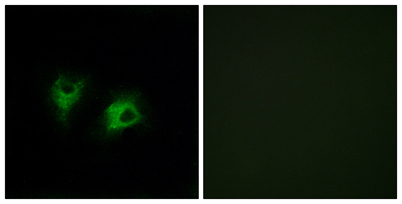
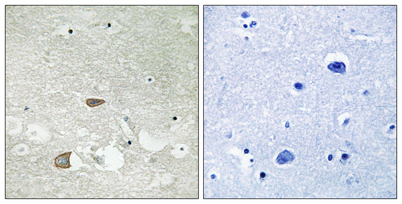
| Dilutions: | Immunohistochemistry: 1/100 - 1/300. Immunofluorescence: 1/200 - 1/1000. ELISA: 1/5000. Not yet tested in other applications. |
| Immunogen: | The antiserum was produced against synthesized peptide derived from human CELSR2. AA range:2781-2830 |
| Storage: | -20°C/1 year |
| Clonality: | Polyclonal |
| Isotype: | IgG |
| Concentration: | 1 mg/ml |
| Molecular Weight: | 317kD |
| GeneID: | 1952 |
| Human Swiss-Prot No: | Q9HCU4 |
| Cellular localization: | Cell membrane; Multi-pass membrane protein. |
| Background: | The protein encoded by this gene is a member of the flamingo subfamily, part of the cadherin superfamily. The flamingo subfamily consists of nonclassic-type cadherins; a subpopulation that does not interact with catenins. The flamingo cadherins are located at the plasma membrane and have nine cadherin domains, seven epidermal growth factor-like repeats and two laminin A G-type repeats in their ectodomain. They also have seven transmembrane domains, a characteristic unique to this subfamily. It is postulated that these proteins are receptors involved in contact-mediated communication, with cadherin domains acting as homophilic binding regions and the EGF-like domains involved in cell adhesion and receptor-ligand interactions. The specific function of this particular member has not been determined. [provided by RefSeq, Jul 2008], |