$148.00/50µL $248.00/100µL
| 50 µL | $148.00 |
| 100 µL | $248.00 |
| Product name: | DNA pol θ rabbit pAb |

| Reactivity: | Human;Rat;Mouse; |
| Alternative Names: | POLQ; POLH; DNA polymerase theta; DNA polymerase eta |
| Source: | Rabbit |
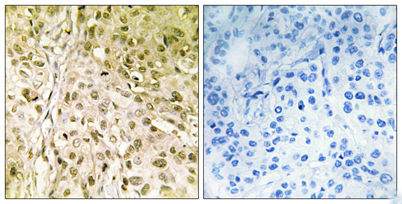
| Dilutions: | Immunohistochemistry: 1/100 - 1/300. ELISA: 1/20000. Not yet tested in other applications. |
| Immunogen: | The antiserum was produced against synthesized peptide derived from human POLQ. AA range:181-230 |
| Storage: | -20°C/1 year |
| Clonality: | Polyclonal |
| Isotype: | IgG |
| Concentration: | 1 mg/ml |
| Molecular Weight: | 198kD |
| GeneID: | 10721 |
| Human Swiss-Prot No: | O75417 |
| Cellular localization: | Nucleus . Chromosome . Enriched in chromatin in response to ultaviolet (UV) light (PubMed:25642963). Binds to chromatin during early G1 (PubMed:24989122). . |
| Background: | POLQ (Polymerase (DNA) Theta) is a Protein Coding gene. Among its related pathways are Platinum Pathway, Pharmacokinetics/Pharmacodynamics and DNA Double-Strand Break Repair. GO annotations related to this gene include nucleic acid binding and damaged DNA binding. An important paralog of this gene is SNRNP200. NA polymerase that promotes microhomology-mediated end-joining (MMEJ), an alternative non-homologous end-joining (NHEJ) machinery triggered in response to double-strand breaks in DNA (PubMed: 25642963, PubMed: 25643323). MMEJ is an error-prone repair pathway that produces deletions of sequences from the strand being repaired and promotes genomic rearrangements, such as telomere fusions, some of them leading to cellular transformation (PubMed: 25642963, PubMed: 25643323). POLQ acts as an inhibitor of homology-recombination repair (HR) pathway by limiting RAD51 accumulation at resected ends (PubMed: 25642963). POLQ-mediated MMEJ may be required to promote the survival of cells with a compromised HR repair pathway, thereby preventing genomic havoc by resolving unrepaired lesions (By similarity). The polymerase acts by binding directly the 2 ends of resected double-strand breaks, allowing microhomologous sequences in the overhangs to form base pairs. It then extends each strand from the base-paired region using the opposing overhang as a template. Requires partially resected DNA containing 2 to 6 base pairs of microhomology to perform MMEJ (PubMed: 25643323). The polymerase activity is highly promiscuous: unlike most polymerases, promotes extension of ssDNA and partial ssDNA (pssDNA) substrates (PubMed: 18503084, PubMed: 21050863, PubMed: 22135286). Also exhibits low-fidelity DNA synthesis, translesion synthesis and lyase activity, and it is implicated in interstrand-cross-link repair, base excision repair and DNA end-joining (PubMed: 14576298, PubMed: 18503084, PubMed: 19188258, PubMed: 24648516). Involved in somatic hypermutation of immunoglobulin genes, a process that requires the activity of DNA polymerases to ultimately introduce mutations at both A/T and C/G base pairs (By similarity). |