
$148.00/50µL $248.00/100µL
| 50 µL | $148.00 |
| 100 µL | $248.00 |
| Product name: | NCX1 rabbit pAb |
| Reactivity: | Human;Mouse;Rat |
| Alternative Names: | SLC8A1; CNC; NCX1; Sodium/calcium exchanger 1; Na(+)/Ca(2+)-exchange protein 1 |
| Source: | Rabbit |
| Dilutions: | Western Blot: 1/500 - 1/2000. ELISA: 1/5000. Not yet tested in other applications. |
| Immunogen: | Synthesized peptide derived from NCX1 . at AA range: 270-350 |
| Storage: | -20°C/1 year |
| Clonality: | Polyclonal |
| Isotype: | IgG |
| Concentration: | 1 mg/ml |
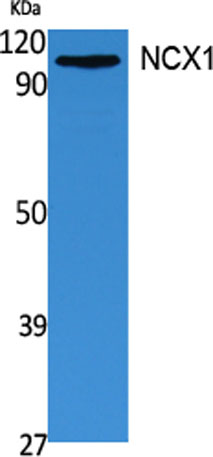
| Observed Band: | 108kD |
| GeneID: | 6546 |
| Human Swiss-Prot No: | P32418 |
| Cellular localization: | Cell membrane ; Multi-pass membrane protein . |
| Background: | In cardiac myocytes, Ca(2+) concentrations alternate between high levels during contraction and low levels during relaxation. The increase in Ca(2+) concentration during contraction is primarily due to release of Ca(2+) from intracellular stores. However, some Ca(2+) also enters the cell through the sarcolemma (plasma membrane). During relaxation, Ca(2+) is sequestered within the intracellular stores. To prevent overloading of intracellular stores, the Ca(2+) that entered across the sarcolemma must be extruded from the cell. The Na(+)-Ca(2+) exchanger is the primary mechanism by which the Ca(2+) is extruded from the cell during relaxation. In the heart, the exchanger may play a key role in digitalis action. The exchanger is the dominant mechanism in returning the cardiac myocyte to its resting state following excitation.[supplied by OMIM, Apr 2004], |