
$148.00/50µL $248.00/100µL
| 50 µL | $148.00 |
| 100 µL | $248.00 |
| Product name: | TCF-4/12 rabbit pAb |
| Reactivity: | Human;Mouse;Rat |
| Alternative Names: | TCF4; BHLHB19; ITF2; SEF2; Transcription factor 4; TCF-4; Class B basic helix-loop-helix protein 19; bHLHb19; Immunoglobulin transcription factor 2; ITF-2; SL3-3 enhancer factor 2; SEF-2; TCF12; BHLHB20; HEB; HTF4; Transcription factor 12; |
| Source: | Rabbit |
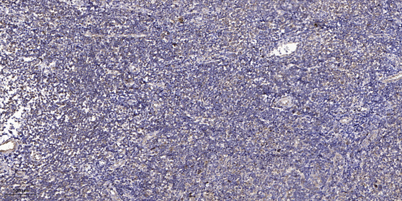
| Dilutions: | Western Blot: 1/500 - 1/2000. Immunohistochemistry: 1/100 - 1/300. ELISA: 1/20000. Not yet tested in other applications. |
| Immunogen: | The antiserum was produced against synthesized peptide derived from human TCF4/12. AA range:581-630 |
| Storage: | -20°C/1 year |
| Clonality: | Polyclonal |
| Isotype: | IgG |
| Concentration: | 1 mg/ml |
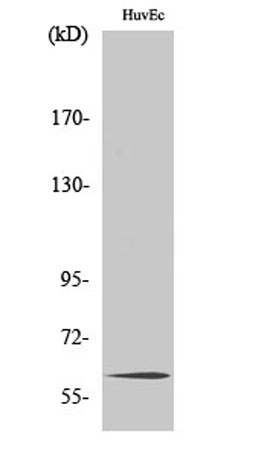
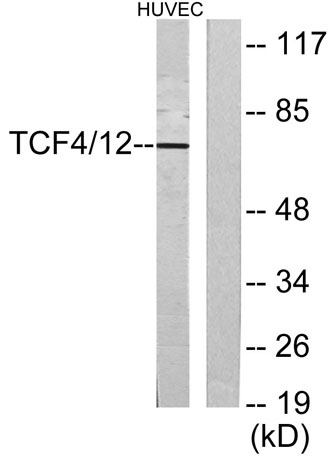
| Observed Band: | 60kD |
| GeneID: | 6925/6938 |
| Human Swiss-Prot No: | P15884/Q99081 |
| Cellular localization: | Nucleus . |
| Background: | This gene encodes transcription factor 4, a basic helix-loop-helix transcription factor. The encoded protein recognizes an Ephrussi-box ('E-box') binding site ('CANNTG') - a motif first identified in immunoglobulin enhancers. This gene is broadly expressed, and may play an important role in nervous system development. Defects in this gene are a cause of Pitt-Hopkins syndrome. In addition, an intronic CTG repeat normally numbering 10-37 repeat units can expand to >50 repeat units and cause Fuchs endothelial corneal dystrophy. Multiple alternatively spliced transcript variants that encode different proteins have been described. [provided by RefSeq, Jul 2016], |


