
$148.00/50µL $248.00/100µL
| 50 µL | $148.00 |
| 100 µL | $248.00 |
| Product name: | PSMD11 rabbit pAb |
| Reactivity: | Human;Mouse |
| Alternative Names: | PSMD11; 26S proteasome non-ATPase regulatory subunit 11; 26S proteasome regulatory subunit RPN6; 26S proteasome regulatory subunit S9; 26S proteasome regulatory subunit p44.5 |
| Source: | Rabbit |
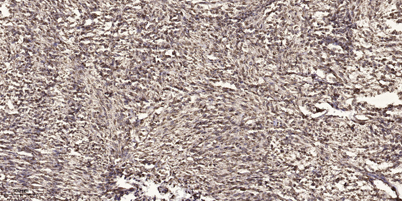
| Dilutions: | Western Blot: 1/500 - 1/2000. Immunohistochemistry: 1/100 - 1/300. ELISA: 1/10000. Not yet tested in other applications. |
| Immunogen: | The antiserum was produced against synthesized peptide derived from human PSMD11. AA range:271-320 |
| Storage: | -20°C/1 year |
| Clonality: | Polyclonal |
| Isotype: | IgG |
| Concentration: | 1 mg/ml |
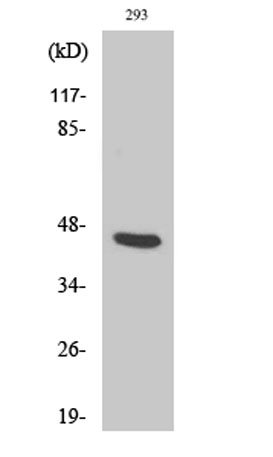
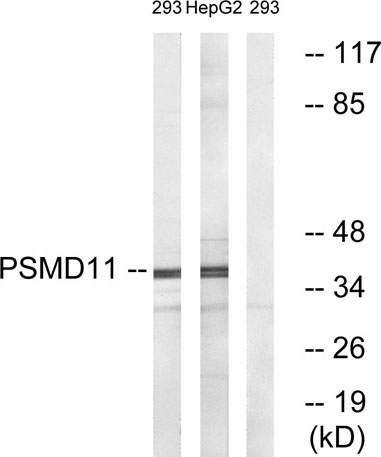
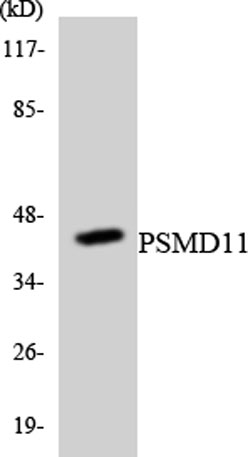
| Observed Band: | 42kD |
| GeneID: | 5717 |
| Human Swiss-Prot No: | O00231 |
| Cellular localization: | Nucleus . Cytoplasm, cytosol . |
| Background: | The 26S proteasome is a multicatalytic proteinase complex with a highly ordered structure composed of 2 complexes, a 20S core and a 19S regulator. The 20S core is composed of 4 rings of 28 non-identical subunits; 2 rings are composed of 7 alpha subunits and 2 rings are composed of 7 beta subunits. The 19S regulator is composed of a base, which contains 6 ATPase subunits and 2 non-ATPase subunits, and a lid, which contains up to 10 non-ATPase subunits. Proteasomes are distributed throughout eukaryotic cells at a high concentration and cleave peptides in an ATP/ubiquitin-dependent process in a non-lysosomal pathway. This gene encodes a member of the proteasome subunit S9 family that functions as a non-ATPase subunit of the 19S regulator and is phosphorylated by AMP-activated protein kinase. Alternatively spliced transcript variants have been observed for this gene. [provided by RefSeq, |


