
$148.00/50µL $248.00/100µL
| 50 µL | $148.00 |
| 100 µL | $248.00 |
| Product name: | CEP290 rabbit pAb |
| Reactivity: | Human;Mouse |
| Alternative Names: | CEP290; BBS14; KIAA0373; NPHP6; Centrosomal protein of 290 kDa; Cep290; Bardet-Biedl syndrome 14 protein; Cancer/testis antigen 87; CT87; Nephrocystin-6; Tumor antigen se2-2 |
| Source: | Rabbit |
| Dilutions: | Western Blot: 1/500 - 1/2000. ELISA: 1/20000. Not yet tested in other applications. |
| Immunogen: | The antiserum was produced against synthesized peptide derived from human CEP290. AA range:771-820 |
| Storage: | -20°C/1 year |
| Clonality: | Polyclonal |
| Isotype: | IgG |
| Concentration: | 1 mg/ml |
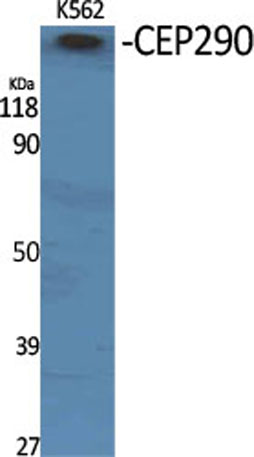
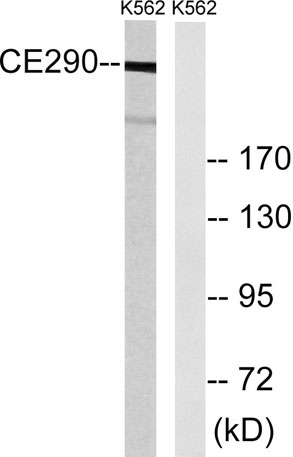
| Observed Band: | 290kD |
| GeneID: | 80184 |
| Human Swiss-Prot No: | O15078 |
| Cellular localization: | Cytoplasm, cytoskeleton, microtubule organizing center, centrosome . Cytoplasm, cytoskeleton, microtubule organizing center, centrosome, centriolar satellite . Nucleus . Cell projection, cilium . Cytoplasm, cytoskeleton, cilium basal body . Cytoplasm, cytoskeleton, microtubule organizing center, centrosome, centriole . Cytoplasmic vesicle . Displaced from centriolar satellites in response to cellular stress, such as ultraviolet light (UV) radiation or heat shock (PubMed:24121310). Found in the connecting cilium of photoreceptor cells, base of cilium in kidney intramedullary collecting duct cells (By similarity). Localizes at the transition zone, a region between the basal body and the ciliary axoneme (PubMed:23943788). Localization at the ciliary transition zone as well as at centriolar sa |
| Background: | centrosomal protein 290(CEP290) Homo sapiens This gene encodes a protein with 13 putative coiled-coil domains, a region with homology to SMC chromosome segregation ATPases, six KID motifs, three tropomyosin homology domains and an ATP/GTP binding site motif A. The protein is localized to the centrosome and cilia and has sites for N-glycosylation, tyrosine sulfation, phosphorylation, N-myristoylation, and amidation. Mutations in this gene have been associated with Joubert syndrome and nephronophthisis and the presence of antibodies against this protein is associated with several forms of cancer. [provided by RefSeq, Jul 2008], |